Call center AI software, robotic process automation services – servicios de automatización robótica de procesos, and strategies for improving service quality with an AI call center are transforming how organizations deliver customer support. Today’s customers expect fast, personalized, always-on assistance across voice, chat, email, and messaging. Traditional contact center tools alone often fall short, creating long queues, fragmented experiences, and higher operational costs.
Call center AI software changes the equation by combining natural language processing (NLP), machine learning, speech recognition, and conversational AI. These technologies automate routine interactions, provide real-time support for human agents, and generate actionable insights across every customer touchpoint. The result: a contact center that is always available, highly efficient, and deeply personalized.
Leading platforms such as Bright Pattern illustrate what’s possible. A global financial services firm using Bright Pattern AI tools improved agent efficiency by 25% and increased first call resolution by 30%, showing that AI doesn’t just cut costs—it transforms the contact center into a strategic engine for customer experience and business growth.
Cloud, Advanced Technology, and AI-Driven Opportunities in Call Centers
Cloud-based AI - flashmobcomputing.org enables scalable, flexible, and cost-effective deployment for modern contact centers. It allows AI models to process thousands of interactions simultaneously without requiring additional on-premises infrastructure. Organizations can deploy virtual agents, predictive routing, and analytics across multiple regions while maintaining security, compliance, and real-time performance. Cloud AI also simplifies updates, experimentation with generative models, and integration with emerging technologies.
Advances in computer technology including faster processors, increased memory, and high-performance storage—underpin AI call center capabilities. These developments enable real-time natural language processing (NLP), predictive modeling, and large-scale analytics without latency. They also make it feasible to integrate AI with legacy systems while maintaining responsive, seamless customer experiences.
AI is not just a support tool, it is a growth engine. Marketing with AI in contact centers to turn interactions into revenue-generating opportunities by analyzing behavioral data, call patterns, and purchase history. AI in marketing can suggest cross-sell and upsell opportunities during live interactions and trigger personalized campaigns based on predicted customer needs, boosting engagement and conversions.
Similarly, financial AI enhances banking, insurance, and fintech support. AI can detect fraud, flag high-risk transactions, and prioritize critical inquiries. Integrating financial AI into call center workflows ensures faster resolution of sensitive requests, strengthens compliance, and maintains customer trust while improving overall agent efficiency.
What is Call Center AI Software?
Call center AI software is an integrated platform that leverages artificial intelligence to automate, augment, and analyze customer interactions across all channels. It introduces intelligent virtual agents, chatbots, and decision engines that understand natural language, detect intent, and act in real time.
Core components include:
- Natural Language Processing (NLP): Understands written and spoken customer interactions and converts them into actionable insights.
- Machine Learning: Recognizes patterns, predicts outcomes, and continuously improves over time using historical data.
- Speech Recognition & Analytics: Converts voice into structured data, identifies trends, and detects sentiment or frustration.
- Conversational AI: Conducts natural, two-way dialogues across voice, chat, and messaging channels.
- Automation & Workflow Engines: Automates repetitive tasks, triggers actions, and updates connected systems.
- Analytics & Reporting: Provides dashboards and detailed metrics for optimizing operations and measuring ROI.
These capabilities allow AI call centers to manage high interaction volumes, maintain consistent quality, and free human agents for complex or sensitive issues.
Top AI Call Center Software Platforms
Organizations looking to modernize their contact centers have several AI-powered options. Here’s a list of leading platforms:
1. Bright Pattern
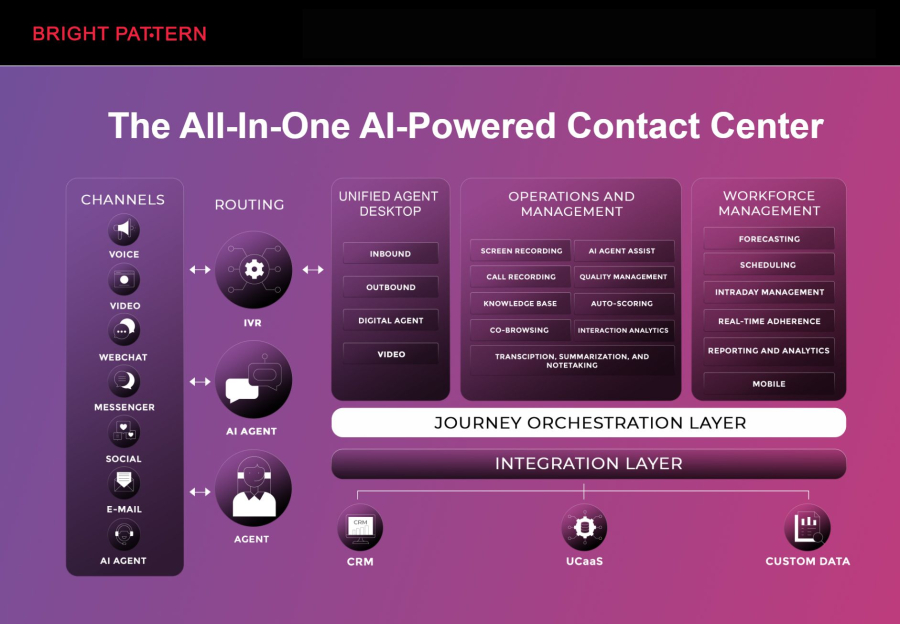
Bright Pattern stands out as a top-tier AI call center platform due to its true omnichannel capabilities, advanced NLP, and seamless cloud deployment. Businesses using Bright Pattern benefit from AI-driven predictive routing, real-time agent assistance, and robust analytics that turn customer interactions into actionable insights. A global financial services firm using Bright Pattern AI tools improved agent efficiency by 25% and increased first call resolution by 30%, demonstrating that AI can transform the contact center into a strategic growth engine. Its platform also offers powerful automation workflows, generative AI assistance, and deep CRM integrations, making it ideal for enterprises seeking to deliver fast, personalized, and scalable customer support.
2. Five9
Five9 provides cloud-based contact center solutions with AI-powered predictive dialing, virtual agents, and omnichannel support. It emphasizes automation and real-time analytics to improve agent productivity and customer satisfaction.
3. Genesys Cloud CX
Genesys offers a comprehensive AI-driven experience, combining chatbots, predictive routing, and workforce optimization tools. It integrates easily with existing CRMs and supports advanced analytics to enhance personalization and operational efficiency.
4. NICE CXone
NICE CXone leverages AI for predictive engagement, sentiment analysis, and automation. Its platform focuses on improving first contact resolution while reducing operational costs through intelligent routing and workflow automation.
5. Talkdesk
Talkdesk uses AI to provide virtual agents, real-time agent guidance, and advanced speech analytics. Its platform is designed for quick deployment and integrates seamlessly with major CRM and business applications.
6. 8x8 Contact Center
8x8 offers AI-powered omnichannel contact center software with virtual agents, predictive analytics, and voice and chat AI. It emphasizes real-time monitoring and actionable insights to boost agent performance.
7. RingCentral Contact Center
RingCentral integrates AI for predictive routing, self-service, and conversational bots. The platform focuses on scalability and consistent omnichannel customer experiences.
8. Cisco Contact Center AI
Cisco’s AI solutions provide virtual agents, sentiment analysis, and automation across voice and digital channels. The platform supports large enterprises with complex workflows and emphasizes security and compliance.
Key Technologies in Call Center AI Software
Natural Language Processing (NLP)
NLP enables AI systems to:
- Identify customer intent (e.g., checking an order status, resetting passwords, or disputing a charge).
- Extract key details such as dates, account numbers, and product names.
- Maintain context across multi-step conversations for a seamless customer experience.
Advanced NLP allows AI agents to understand free-form questions, clarify ambiguous requests, and escalate appropriately.
Machine Learning & Predictive Models
Machine learning powers continuous improvement:
- Predictive Routing: Directs customers to the agent or bot most likely to resolve their issue.
- Next-Best-Action Suggestions: Provides agents with optimal responses or offers during live interactions.
- Demand Forecasting: Predicts call, chat, and email volumes for better staffing and resource allocation.
Unlike static scripts, AI models adapt dynamically to changing customer behaviors and product updates.
Speech Recognition & Analytics
AI can interpret spoken words and detect sentiment:
- Real-time transcription: Converts calls into structured data instantly.
- Emotion detection: Identifies frustration, satisfaction, or urgency in tone and wording.
- Keyword spotting: Flags phrases relevant for compliance, quality, or product monitoring.
This enables coaching, quality assurance, and post-call optimization at scale.
Conversational AI & Generative AI
Conversational AI orchestrates interactions using intent detection, context, and business rules. Generative AI enhances service by:
- Drafting agent responses automatically for review.
- Summarizing long calls or chats into concise notes and dispositions.
- Highlighting relevant knowledge base articles and documentation.
This results in faster, more accurate customer service with reduced manual effort.
Integrations & Data Layer
Modern call center AI software integrates with CRM, ticketing, workforce management, marketing automation, and collaboration platforms. A unified data layer ensures agents and AI systems have access to a 360-degree view of the customer, enabling personalization and high first contact resolution.
Business Benefits of Call Center AI Software
AI call center software transforms traditional contact centers into strategic, data-driven customer experience hubs, delivering measurable benefits across operations, customer satisfaction, and revenue generation.
24/7 Availability
Virtual agents and AI-powered self-service platforms ensure customers can access support anytime, across any channel—voice, chat, email, or messaging apps. This not only reduces wait times but also allows global businesses to serve customers across time zones without the cost of 24/7 human staffing. For example, an e-commerce company implementing AI virtual agents saw a 40% decrease in after-hours inquiries handled manually.
Faster Response Times
AI accelerates response by automating common queries, providing instant solutions, and routing complex issues to the right agent. By minimizing wait times, organizations improve customer satisfaction and reduce drop-offs during peak hours. Real-time AI suggestions also empower agents to respond more quickly and accurately, enhancing the overall experience.
Lower Operational Costs
Automating routine interactions with AI reduces handle times, decreases escalations, and optimizes workforce planning. Organizations can redeploy human agents to high-value tasks, cutting costs without compromising service quality. Companies have reported up to 30% reductions in operational expenses after implementing AI call center software alongside robotic process automation.
Higher First Contact Resolution
Predictive routing, intelligent IVR, and real-time agent assistance help resolve issues on the first contact. AI analyzes historical interactions and customer data to match inquiries with the best-skilled agent, reducing transfers and follow-ups. Higher first contact resolution translates directly into stronger customer loyalty and lower operational strain.
Enhanced Personalization
By integrating AI insights with CRM and behavioral data, call centers can tailor conversations to individual customer needs. From recognizing returning customers to anticipating issues before they escalate, AI enables a level of personalization previously impossible with manual processes. Personalized interactions lead to higher satisfaction, repeat business, and increased lifetime value.
Improved Agent Productivity
AI reduces cognitive load on agents by handling repetitive tasks, surfacing relevant knowledge, and suggesting next best actions. Agents can focus on complex or emotionally sensitive issues, while AI ensures consistent service quality. This also shortens onboarding for new hires and supports career development by allowing agents to tackle more rewarding challenges.
Actionable Analytics
AI platforms generate rich insights from every interaction, analyzing sentiment trends, identifying pain points, and highlighting emerging issues. Organizations can use these insights to optimize workflows, improve scripts, design targeted training, and drive process improvements. Unlike traditional sampling methods, AI provides a full-picture view, ensuring decisions are data-driven.
Scalability and Flexibility
Cloud-based AI call center software scales automatically to handle traffic spikes, seasonal demand, or business growth. Businesses can expand service capabilities without the linear costs of hiring additional staff. This flexibility allows organizations to maintain consistent service quality, even during unexpected surges in contact volume.
Strategic Business Impact
Beyond operational efficiency, AI call center solutions help transform the contact center into a strategic hub. Insights from AI interactions inform product development, marketing strategies, and customer retention initiatives. By turning customer interactions into actionable data, organizations can make proactive decisions that drive revenue and competitive advantage.
Key Benefits and Features of Call Center AI Software
|
Benefit / Outcome |
How AI Call Center Software Delivers It |
Example / Result |
|
24/7 Availability |
Virtual agents handle routine queries anytime |
Customers get instant answers without waiting |
|
Faster Response Times |
Automates common questions and workflows |
Reduced average handle time |
|
Lower Operational Costs |
AI deflects calls, reduces escalations, optimizes staffing |
Fewer overtime hours, lower per-contact cost |
|
Higher First Contact Resolution |
Predictive routing, smarter IVR, real-time agent assist |
Increased resolution on first call |
|
Enhanced Personalization |
AI + CRM + behavioral data deliver tailored interactions |
Higher CSAT and loyalty |
|
Improved Agent Productivity |
Repetitive tasks handled by AI; real-time agent suggestions |
Agents spend more time on complex issues |
|
Actionable Analytics |
Full transcripts, sentiment trends, operational dashboards |
Data-driven process improvement and coaching |
|
Scalability |
Cloud-based AI handles spikes and growth without extra staff |
Supports seasonal peaks or global expansion |
AI Call Center Software vs Traditional Contact Centers
|
Feature |
Traditional Contact Centers |
AI Call Center Software |
|
Response Time |
Manual handling, long queues |
Instant response via virtual agents |
|
Availability |
Business hours only |
24/7 self-service & live AI support |
|
Personalization |
Limited to agent memory |
Data-driven personalization using CRM & AI insights |
|
Cost Efficiency |
High staffing & overtime costs |
Reduced handle time, fewer escalations, lower cost per contact |
|
Agent Support |
Manual scripting and training |
Real-time agent assist and suggested responses |
|
Analytics |
Small sample QA, limited insight |
Full-transcript analytics, sentiment, and operational dashboards |
|
Scalability |
Requires hiring more agents |
Cloud-based AI scales automatically |
|
Proactive Engagement |
Mostly reactive |
Predictive AI identifies opportunities & triggers outreach |
Practical Applications Across the Customer Journey
AI touches every stage of the customer journey, enabling smarter, faster, and more personalized interactions across all touchpoints.
Always-On Virtual Agents and Chatbots
AI virtual agents handle high-volume, repetitive tasks such as checking order status, resetting passwords, updating account information, and answering frequently asked questions. These bots operate 24/7, managing thousands of concurrent conversations, which reduces wait times, improves customer satisfaction, and frees human agents for complex tasks.
For instance, a telecom company integrated virtual agents to handle routine billing inquiries, resulting in a 50% reduction in call volume routed to live agents.
Intelligent IVR and Voice Bots
Traditional IVR systems often frustrate customers with rigid menus. AI-powered voice bots allow customers to speak naturally and get tasks completed efficiently. These systems can authenticate users, perform routine actions, and route calls intelligently to the right agent if human intervention is needed. This approach shortens call times, reduces transfers, and enhances the voice experience.
Predictive Call Routing and Dynamic Queues
AI ensures that customers are matched with the most suitable agent or AI resource based on skills, history, language, and predicted outcomes. Dynamic queue management prioritizes high-value or urgent cases, ensuring customers get faster resolutions. Businesses using predictive routing have reported higher first contact resolution and reduced abandonment rates.
Real-Time Agent Assist and Coaching
During live interactions, AI monitors conversations, providing agents with suggested responses, knowledge base articles, and procedural guidance. It can also detect customer sentiment and alert supervisors when intervention may be needed. This ensures consistent quality, supports agent performance, and enhances customer confidence.
Example: A financial services firm using real-time AI agent assist reduced errors by 20% and increased agent confidence during complex calls.
Post-Call Analytics, Quality, and Workforce Insights
AI analyzes 100% of interactions for insights on common issues, compliance risks, and agent performance. Sentiment analysis helps identify trends across channels, products, or regions. Managers can use this data to optimize scripts, train agents, and improve operational processes proactively rather than reactively.
Proactive and Outbound Engagement
AI allows organizations to anticipate customer needs and initiate contact proactively. Automated alerts for appointment reminders, service disruptions, order updates, and subscription renewals enhance the customer experience while deflecting inbound inquiries. This predictive engagement strengthens loyalty and can reduce churn.
Multi-Channel and Omnichannel Support
AI seamlessly integrates across voice, chat, email, messaging apps, and social platforms, ensuring customers receive consistent support regardless of channel. Unified customer histories allow AI and human agents to provide personalized and informed responses, making every interaction meaningful.
Must-Have Features in AI Call Center Software
Selecting the right AI call center software is critical to maximizing efficiency, customer satisfaction, and ROI. A robust platform should go beyond basic automation or chatbots and include a comprehensive set of integrated features that work seamlessly together.
1. True Omnichannel Support
The software should handle voice, web chat, email, messaging apps, and in-app messaging in a unified platform. A true omnichannel system ensures a consistent customer experience across all touchpoints and allows agents to view a complete interaction history, regardless of channel.
Example: A retail company using omnichannel AI software can follow a customer from a web chat about a product to a follow-up phone call without repeating information.
2. Advanced Natural Language Processing (NLP)
NLP enables AI to understand and process customer queries in natural, free-form language. Look for platforms that support both text and voice, can detect intent, handle ambiguous queries, and maintain context across multiple interactions.
Benefit: This allows virtual agents to resolve more requests autonomously and improves overall first contact resolution.
3. Voice AI and Speech Analytics
AI call center software should include real-time transcription, emotion detection, and keyword spotting. Speech analytics provide insights into customer sentiment, detect compliance risks, and identify common issues, which can inform coaching and operational improvements.
Example: A bank can detect frustration during a loan inquiry and escalate the call to a senior agent before the situation worsens.
4. Intelligent Routing
Predictive routing and dynamic queue management match customers with the most appropriate agent or AI assistant based on skills, history, and predicted outcomes. This ensures high-value or urgent inquiries receive priority and improves first contact resolution.
Benefit: Reduces call transfers and decreases overall handle time.
5. Real-Time Analytics and Dashboards
The platform should provide actionable metrics on agent performance, service levels, customer satisfaction, and operational efficiency. Dashboards must allow managers to monitor live interactions, identify trends, and make data-driven decisions quickly.
Example: Real-time dashboards can alert managers to sudden spikes in call volume, allowing for immediate staffing adjustments.
6. Deep CRM and Helpdesk Integration
Integration with CRM, ticketing, knowledge bases, and ERP systems is essential for delivering personalized service. AI agents should have access to full customer histories, preferences, past interactions, and pending cases.
Benefit: Enables contextual responses and reduces repetitive questioning, enhancing the customer experience.
7. Automated Workflows and After-Call Work
AI should automate post-interaction tasks such as ticket creation, survey follow-ups, order updates, or case documentation. This reduces manual effort for agents and ensures data consistency across systems.
Example: After a resolved support call, the AI can automatically log the case, update the CRM, and send a follow-up satisfaction survey.
8. Virtual Agents and Self-Service Capabilities
AI call center software should include robust virtual agents capable of handling high-volume, repeatable tasks 24/7. Self-service options empower customers to resolve issues without agent intervention while maintaining a seamless experience.
Benefit: Reduces operational costs and frees agents to focus on complex or high-value interactions.
9. Multilingual Support
Global organizations need AI that can converse fluently in multiple languages, providing consistent service to customers worldwide without separate teams for each language.
Example: AI virtual agents can handle inquiries in English, Spanish, French, and Mandarin, ensuring broad accessibility.
10. Cloud-Based, Scalable Architecture
A cloud-native platform supports growth, seasonal peaks, and remote teams. Scalability ensures the system can handle thousands of simultaneous interactions without degradation in performance.
Benefit: Organizations can expand AI capabilities without heavy infrastructure investments.
11. Security, Privacy, and Compliance Features
AI software must comply with GDPR, CCPA, and industry-specific regulations. Look for encryption, role-based access, audit trails, and data retention policies to ensure sensitive customer data is protected.
Example: Financial institutions can use AI to monitor transactions securely while adhering to regulatory requirements.
12. Generative AI and Real-Time Assistance
Modern AI platforms can suggest agent responses, summarize conversations, and provide knowledge prompts in real time. Generative AI reduces agent workload, speeds resolution, and ensures more accurate, context-aware communication.
Benefit: Helps new or less experienced agents perform at a higher level and improves overall customer satisfaction.
13. Proactive Engagement Capabilities
AI should not only respond to customer requests but also predict potential needs and trigger proactive outreach, such as reminders, alerts, or follow-ups.
Example: Healthcare call centers can automatically remind patients about upcoming appointments or prescription refills.
